
the map nobody gave you
UNBOXED PARENTING
Practical parenting scripts, calm boundaries and repair for the moments that matter most
You love your child.
But love does not automatically tell you what to say when your child is melting down, arguing, lying, refusing, hitting, fighting with a sibling, or raging because screen time ended.
And it does not automatically keep you calm when you are exhausted, rushed, overstimulated, or running on an empty cup.
Most parents do not need another lecture about being more patient.
They need practical language.
They need clear boundaries.
They need a way to respond when emotions are high and everyone’s nervous system is overloaded.
Unboxed Parenting gives parents the words and tools to remain kind, firm and connected—without becoming permissive and without relying on yelling, shame or fear.
WHEN YOU KNOW WHAT NOT TO SAY—BUT DO NOT KNOW WHAT TO SAY INSTEAD
Parenting advice often sounds clear until you are inside the actual moment.
Your child refuses to leave.
The screen needs to turn off.
Someone hits a sibling.
Your child lies about homework.
Bedtime becomes a negotiation.
You ask five times and are ignored.
You feel your voice sharpening.
You know you do not want to yell.
You also know the boundary cannot simply disappear.
This is where many parents become trapped between two extremes.
Too hard
You raise your voice, threaten, shame, dominate or force immediate compliance.
The behavior may stop, but the emotional cost remains.
Too soft
You negotiate endlessly, repeat yourself, avoid the conflict or surrender the boundary because you no longer have the capacity to hold it.
The immediate pressure ends, but the pattern becomes harder the next time.
Unboxed Parenting offers a third path:
Kind and firm
The child’s feelings are acknowledged.
The boundary remains real.
The next step is clear.
And repair is available when the moment does not go well.
This is not perfect parenting.
It is structured, emotionally safe parenting that works in real homes.
WHAT IS UNBOXED PARENTING?
Unboxed Parenting is a practical parenting framework based on a simple idea:
You are not only raising behavior. You are raising meaning.
Children do not experience a difficult moment only through the words a parent intended.
They absorb tone.
Facial expression.
Emotional safety.
Whether the boundary stayed stable.
Whether connection disappeared.
Whether the parent returned after becoming overwhelmed.
A child may hear:
“Put your shoes on.”
But beneath the words, the child may conclude:
“When I struggle, I become a problem.”
“When I make mistakes, people become harsh.”
“I have to be easy to remain loved.”
“My emotions are too much.”
“I am responsible for keeping adults calm.”
When conclusions like these repeat, they can become invisible emotional walls.
The Unboxed Parenting method helps parents interrupt that sequence.
Moment → Meaning → Wall → Box
A moment happens.
The child assigns meaning.
Repeated meaning creates a wall.
Over time, those walls shape identity, relationships, confidence, emotional regulation and behavior.
The goal is not to eliminate every difficult moment.
The goal is to keep difficult moments from becoming damaging conclusions about the child.
A DIFFERENT WAY TO HANDLE DIFFICULT BEHAVIOR
Traditional parenting often begins with one question:
How do I stop this behavior?
Unboxed Parenting begins with several:
What state is my child in?
What meaning could this moment create?
What boundary is still required?
What is the next achievable step?
Does this moment need teaching, containment or repair?
This changes how parents respond to tantrums, defiance, lying, aggression, screen battles and emotional shutdown.
Behavior still matters.
Accountability still matters.
Consequences still exist.
But the child’s identity is not placed on trial.
Instead of:
“You are being bad.”
The message becomes:
“That behavior is not okay. You are safe. Now we repair it.”
Instead of:
“What is wrong with you?”
The parent asks:
“What happened, and what is the next step?”
Instead of:
“Stop crying.”
The parent says:
“You can be upset. I will not let you hurt anyone.”
This is not weaker parenting.
It is clearer parenting.
PARENTING SCRIPTS FOR REAL-LIFE MOMENTS
Traditional parenting often begins with one question:
How do I stop this behavior?
Unboxed Parenting begins with several:
What state is my child in?
What meaning could this moment create?
What boundary is still required?
What is the next achievable step?
Does this moment need teaching, containment or repair?
This changes how parents respond to tantrums, defiance, lying, aggression, screen battles and emotional shutdown.
Behavior still matters.
Accountability still matters.
Consequences still exist.
But the child’s identity is not placed on trial.
Instead of:
“You are being bad.”
The message becomes:
“That behavior is not okay. You are safe. Now we repair it.”
Instead of:
“What is wrong with you?”
The parent asks:
“What happened, and what is the next step?”
Instead of:
“Stop crying.”
The parent says:
“You can be upset. I will not let you hurt anyone.”
This is not weaker parenting.
It is clearer parenting.
PARENTING SCRIPTS FOR REAL-LIFE MOMENTS
When emotions rise, parents often lose access to long explanations.
That is why Unboxed Parenting uses short, repeatable parenting scripts.
For tantrums and big feelings
“You are safe.”
“You can be upset. You cannot hurt.”
“Safe body. Then we solve.”
“I am here. We will talk when your body is calm.”
For defiance and arguing
“I hear you. The boundary stays.”
“I am not arguing. I am helping you take the next step.”
“The answer is no. Here is what happens next.”
“You may disagree respectfully.”
For difficult transitions
“You do not have to like it. It is still time to go.”
“First this, then that.”
“Choose: you do it, or I help.”
“One step. Then we reassess.”
For mistakes
“That happened. You are safe. Now we repair.”
“Mistakes are information, not identity.”
“Try again.”
“What is the next small step?”
For connection anxiety
“We are okay. Love stays.”
“I am correcting behavior, not rejecting you.”
“You do not have to earn my love.”
“The boundary stays, and so does connection.”
For parental overwhelm
“I am getting overwhelmed. I am pausing so I can stay kind.”
“You are safe.”
“The boundary stays.”
“I am coming back.”
These phrases are not magic words.
They are tools that help parents remain grounded when the nervous system wants to control, collapse, lecture or escape.
EMOTIONAL REGULATION FOR PARENTS AND CHILDREN
A child cannot consistently borrow calm from an adult who is already overwhelmed.
That does not mean parents must be perfectly regulated.
It means parents need a reliable way to recognize their state and adjust their response.
Unboxed Parenting uses a simple Traffic Light Protocol.
Green: teach
You and your child are calm enough to think, communicate and solve problems.
This is the time for:
conversations;
problem-solving;
skill practice;
planning;
reflection;
and learning.
Green script:
“Let’s solve this together.”
Yellow: simplify
Emotional pressure is rising.
This is not the time for a long lecture.
Use fewer words, clearer structure and smaller steps.
Yellow script:
“I am getting stressed, so I am keeping this simple. The boundary stays. Here is the next step.”
Red: contain and pause
Someone is emotionally flooded.
Teaching will not land.
The immediate goal is physical and emotional safety.
Red script:
“You are safe. I will not let harm happen. We will talk when we are calm.”
For an overwhelmed parent:
“I am overwhelmed. I am pausing so I can stay kind. I am coming back.”
The return matters.
A pause can regulate the moment.
A pause without return can feel like withdrawal.
FIRM BOUNDARIES WITHOUT SHAME OR PERMISSIVENESS
Parents often worry that emotionally responsive parenting means allowing children to do whatever they want.
It does not.
Children need structure.
They need adults who mean what they say.
They need rules that remain real even when feelings become intense.
The Unboxed Parenting approach holds two truths at the same time:
Feelings are allowed.
Harm is not.
A child may be angry.
The child may not hit.
A child may dislike a boundary.
The boundary may still remain.
A child may cry when screen time ends.
The screen can still turn off.
A child may feel disappointed by a consequence.
The consequence can still be appropriate.
Useful boundary scripts include:
“You can be mad. You cannot be mean.”
“Feelings are allowed. Harm is not.”
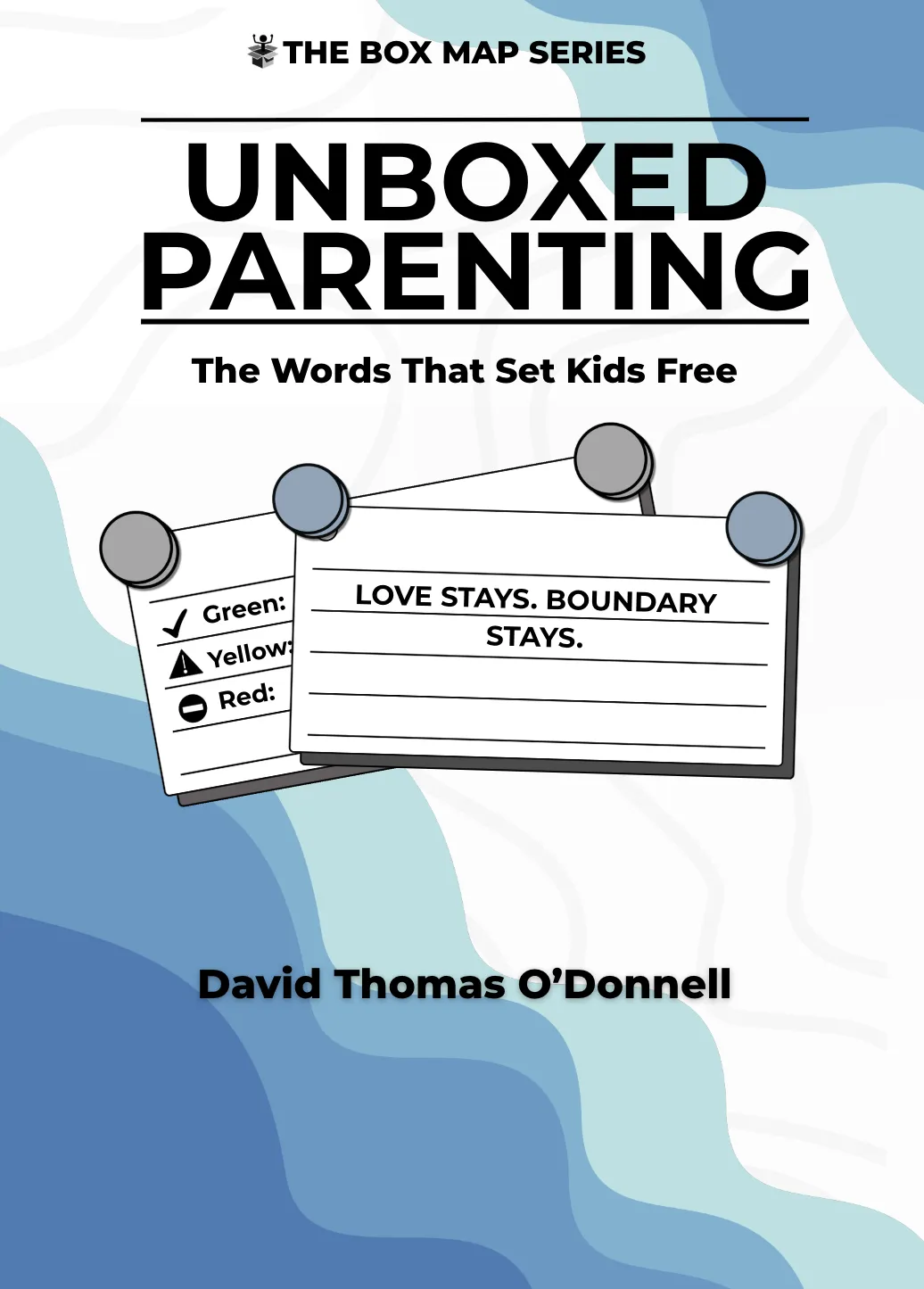
“Love stays. Boundary stays.”
“I will not shame you for being stuck. I will help you take the next step.”
“You do not have to agree. You do have to follow the boundary.”
“I will listen when the words are respectful.”
Unboxed Parenting is not about removing parental authority.
It is about using authority without turning it into fear, shame or emotional rejection.
HOW TO STOP YELLING AT YOUR CHILD—WITHOUT EXPECTING PERFECTION
Many parents search for ways to stop yelling because they are frightened by their own tone.
They hear words from their childhood coming through their mouth.
They see their child’s face change.
Then guilt and shame arrive.
The answer is not simply:
“Never get angry.”
Anger is human.
Overwhelm is human.
Parental depletion is real.
The more useful goal is:
notice your state earlier;
simplify before you explode;
pause before causing harm;
return after the pause;
and repair quickly when you miss the moment.
A depleted parent can use this minimum script:
“I am overwhelmed.”
“I am pausing so I can stay kind.”
“You are safe.”
“The boundary stays.”
“I am coming back.”
This allows the parent to step away without abandoning leadership.
And when yelling does happen, the next step is not pretending it did not happen.
The next step is repair.
HOW TO REPAIR AFTER YELLING AT YOUR CHILD
Repair does not remove authority.
It demonstrates authority with accountability.
A strong parental repair might sound like:
“I got overwhelmed.”
“My tone was harsh.”
“That may have felt scary.”
“You are loved, and you belong.”
“The boundary still stands.”
“Let me try again.”
Then the parent repeats the original boundary calmly.
For example:
“I should not have yelled about the screen. The screen is still finished for tonight. Let me say that again respectfully.”
Repair teaches a child:
adults can take responsibility;
conflict does not end connection;
mistakes can be corrected;
love remains stable;
and accountability does not require shame.
Repair is not the absence of discipline.
It is the restoration of safety after discipline went off course.
HELP FOR COMMON PARENTING CHALLENGES
The Unboxed Parenting method can be applied to the moments that create the greatest stress in family life.
Tantrums and meltdowns
Understand when a child is unable—not merely unwilling—to access reasoning.
Learn when to coach, when to simplify and when to focus only on safety.
Arguing and power struggles
Stop entering endless debates.
Use calm, short boundaries and choices that preserve parental leadership.
Screen-time battles
Create predictable warnings, shutdown routines and transition bridges so ending screen time does not feel like falling off a cliff.
Sibling conflict
Move away from courtroom parenting and toward containment, impact, repair and redo.
Lying and hiding
Make honesty safer than concealment while preserving meaningful consequences and rebuilding trust.
Perfectionism and “I can’t”
Remove identity threat from mistakes and help children take small, achievable steps through frustration.
Attention-seeking and clinginess
Replace unpredictable access with reliable return and brief, intentional connection deposits.
Parental burnout and emotional overload
Use state-based scripts so you can simplify, pause and return instead of swinging between yelling and giving in.
PARENTING WITHOUT PASSING ON THE BOX
Most parents are not trying to hurt their children.
They are trying to get through the moment.
Get out the door.
End the argument.
Stop the hitting.
Finish homework.
Turn off the screen.
Make it through bedtime.
But pressure can cause parents to reach for inherited language and survival responses.
Control.
Withdrawal.
Shame.
Threats.
Overexplaining.
Giving in.
Unboxed Parenting helps parents recognize those patterns without turning recognition into more self-attack.
The question is not:
“Am I a bad parent?”
The better questions are:
“What did I learn under pressure?”
“What meaning might my child be absorbing?”
“What boundary still matters?”
“How can I return?”
You do not break cycles by becoming a perfect parent.
You break cycles by noticing sooner, repairing faster and building a more reliable pattern over time.
IS UNBOXED PARENTING THE SAME AS GENTLE PARENTING?
Unboxed Parenting shares several values commonly associated with gentle parenting:
respect for the child;
emotional awareness;
reduced shame;
curiosity about behavior;
and protection of the parent-child relationship.
But it should not be confused with permissive parenting.
Unboxed Parenting does not ask parents to negotiate every limit.
It does not require endless validation.
It does not place the child in charge of the household.
It does not remove consequences.
It does not expect parents to remain perfectly calm.
The method combines:
Connection
The child remains safe, loved and worthy.
Boundaries
Limits remain clear and consistent.
Direction
The child is shown what to do next.
Repair
When the parent or child causes harm, the relationship and behavior are repaired.
This is a practical middle path between fear-based control and exhausted permissiveness.
WHO IS UNBOXED PARENTING FOR?
Unboxed Parenting is for parents who:
love their children but feel overwhelmed by difficult behavior;
worry that they are either too hard or too soft;
want practical parenting scripts rather than abstract advice;
frequently lose patience and regret their tone;
struggle with tantrums, defiance, screens or sibling conflict;
want firm boundaries without shame;
recognize patterns from their own childhood;
want to stop yelling without becoming permissive;
need help repairing after difficult moments;
and want to raise emotionally secure children without expecting perfection from themselves.
It is especially useful for high-functioning parents who carry significant responsibility and often reach difficult family moments with very little capacity left.
THE CORE UNBOXED PARENTING METHOD
When a difficult moment happens, use this sequence:
Pause
Notice your own state before reacting automatically.
Boundary
State the limit clearly and briefly.
Next Step
Tell the child what can happen now.
Repair—if needed
Return and repair if the moment became harsh, frightening or disconnected.
Examples:
“I am getting overwhelmed. I am pausing.”
“You may be upset. Hitting is not allowed.”
“Sit beside me or take space in your room.”
“My tone became too harsh. Let me try again.”
The method is intentionally simple.
Parents do not need another complicated standard to fail.
They need something they can remember when the house is loud.
THE WORDS THAT SET KIDS FREE
Unboxed Parenting by David Thomas O’Donnell
Unboxed Parenting: The Words That Set Kids Free is a practical field manual for parents who want to change what difficult moments come to mean.
It includes tools for:
emotional regulation;
tantrums and meltdowns;
firm boundaries;
parental overwhelm;
screen-time conflict;
sibling rivalry;
truth and trust;
correction without rejection;
repair after yelling;
and building an Unboxed home culture.
The goal is not a home without conflict.
The goal is a home where conflict does not become identity.
Where boundaries do not threaten belonging.
Where truth gets help.
Where parents can pause and return.
Where mistakes lead to repair instead of shame.
And where children do not have to shrink in order to remain loved.
Discover the book, practical scripts and Unboxed Home tools.
What is the best way to stay calm during a child’s tantrum?
Begin by reducing your language. Avoid lecturing or trying to reason with a child who is emotionally flooded. Focus on safety, use a calm repeated phrase and save teaching for later.
Try:
“You are safe. I will not let you hurt anyone. We will talk when your body is calm.”
How do I set boundaries without yelling?
Use fewer words and make the next action clear.
Try:
“I hear that you are upset. The boundary stays. Here is what happens next.”
Consistency matters more than volume.
What should I do after I yell at my child?
Repair directly. Name what you did without blaming the child, protect the child’s sense of belonging and restate the boundary calmly.
Try:
“I yelled. That was not okay. You are loved. The boundary still stands. Let me try again.”
Does apologizing weaken parental authority?
No. A clear apology models responsibility. You can repair your tone while maintaining the original boundary or consequence.
Is Unboxed Parenting permissive?
No. The approach combines emotional safety with firm limits, follow-through, accountability and age-appropriate consequences.
What if my child keeps arguing after I set a boundary?
Avoid entering a courtroom. Repeat the boundary briefly, offer a controlled choice where appropriate and move toward action.
Try:
“I am not debating this. You may choose A or B.”
Can these parenting tools help with screen-time battles?
Yes. The method uses predictable warnings, calm shutdown boundaries, transition bridges and replacement regulation activities to make screen transitions more manageable.
Do I need to use every tool at once?
No. Choose one recurring problem and install one phrase or protocol for seven days. Consistent small changes are more useful than trying to transform the entire household overnight.
START WITH ONE MOMENT
You do not need to become a different parent today.
Choose one moment that repeatedly goes wrong.
Mornings.
Screens.
Bedtime.
Homework.
Sibling fights.
Tantrums.
Your own overwhelm.
Then choose one sentence.
Practice it until it becomes easier to access under pressure.
That is how a household begins changing.
Not through perfection.
Through repetition.
Through return.
Through repair.
Love stays. Boundary stays.
Learn about The Box Map
COMPANY
CUSTOMER CARE
LEGAL


© Copyright 2026. NV, USA. All Rights Reserved.