
the map nobody gave you
The Map
Why You Feel Stuck: The Structure Beneath the Life You Learned to Live
Most people are taught to interpret struggle personally.
They assume they need more discipline.
More motivation.
More confidence.
Better habits.
A stronger mindset.
But sometimes the problem is not the person.
Sometimes the problem is the structure the person adapted to.
The Box Map is a way of seeing that structure.
It helps explain how a person can remain capable, productive, responsible, and outwardly successful while feeling increasingly constrained inside their own life.
The Box is not a diagnosis.
It is not a label.
It is not proof that something is wrong with you.
It is a map of adaptation.
A way to understand how old emotional material, inherited meanings, protective control, and resistance can quietly shape the size of the life you believe is available to you.
The Box is not who you are.
It is the structure you learned to live inside.
HOW THE BOX FORMS
The Box does not usually arrive through one dramatic event.
It forms gradually.
A moment happens.
The moment creates meaning.
The meaning becomes a conclusion.
The conclusion begins shaping behavior, identity, relationships, and possibility.
Over time, those conclusions become structural.
They influence what feels safe.
What feels dangerous.
What feels realistic.
What feels possible for someone like you.
The Box forms through four primary elements:
The Floor
The Walls
The Ceiling
The Fence
Each part serves a different protective function.
Together, they create the internal environment a person learns to call normal.
THE FLOOR
What was carried but never fully processed
The Floor is made from what had to be set down.
Not because it did not matter.
Because life had to continue.
The conversation that never reached resolution.
The grief that had no room to move.
The anger that was not safe to express.
The disappointment that had to be swallowed.
The shame covered by achievement.
The hurt postponed in the name of being strong, practical, responsible, or mature.
Most people do not consciously decide to suppress these experiences.
They adapt.
They keep moving.
They handle what needs to be handled.
They tell themselves they will deal with it later.
Later rarely comes.
So the experience is contained rather than fully processed.
Over time, containment becomes accumulation.
The Floor rises slowly.
The person still fits.
Still functions.
Still stands.
But with less room.
Less flexibility.
Less margin.
Less access to play, spontaneity, rest, and emotional movement.
From inside the Box, this can look like:
chronic heaviness;
irritability without a clear cause;
emotional numbness;
exhaustion that rest does not fully resolve;
reduced patience;
difficulty accessing joy;
feeling burdened by ordinary demands;
and the sense that everything requires more energy than it should.
The Floor is not made of weakness.
It is made of what was carried alone.
Floor principle:
What is unprocessed does not disappear. It becomes part of the space you live inside.
THE WALLS
The meanings that became limits
The Walls are made of conclusions.
Something happened.
You reacted.
You learned.
At the time, the learning may have protected you.
It may have helped you preserve belonging.
Avoid humiliation.
Reduce conflict.
Stay accepted.
Maintain stability.
The original conclusion may have sounded like:
Do not be too much.
Do not need too much.
Do not disappoint people.
Do not make mistakes.
Stay useful.
Stay agreeable.
Stay strong.
Do not show weakness.
Do not create problems.
Keep everyone comfortable.
Success keeps you safe.
Control keeps you safe.
Visibility is dangerous.
Love must be earned.
Rest must be justified.
These meanings often begin as intelligent responses to real conditions.
The problem is not that they formed.
The problem is that they hardened.
What began as a conclusion becomes an assumption.
What became an assumption begins to feel like fact.
Eventually, the Wall no longer says:
“This happened before.”
It says:
“This is how life works.”
Or:
“This is who I am.”
The Walls shape what you pursue and what you avoid.
They filter possibility before conscious thought.
They determine which desires feel legitimate and which feel irresponsible.
They influence relationships, ambition, boundaries, self-expression, parenting, and the roles you allow yourself to occupy.
From inside the Box, the Walls can look like:
people-pleasing;
perfectionism;
emotional withdrawal;
chronic self-censorship;
over-responsibility;
fear of disappointing others;
difficulty receiving support;
staying in roles that no longer fit;
and rejecting possibilities before testing them.
The Walls do not need to imprison you by force.
They only need to convince you that there is nowhere else to go.
Wall principle:
A conclusion repeated long enough begins to feel like reality.
THE CEILING
The control that limits expansion
The Ceiling is built from caution.
Control.
Certainty.
Responsibility.
The desire to prevent disruption.
Unlike the Walls, which often feel inherited, the Ceiling can feel intentional.
It is reinforced by reasonable decisions.
Do not risk too much.
Do not destabilize what works.
Keep expectations manageable.
Stay within known limits.
Do not create unnecessary problems.
These choices may be intelligent.
Often, they are.
But when control becomes the primary strategy for emotional safety, life begins to lose altitude.
The Ceiling does not eliminate desire.
It compresses it.
It keeps possibility contained enough to manage.
A person may still have ambition, imagination, and longing.
But those parts remain beneath a limit designed to preserve predictability.
From inside the Box, the Ceiling can look like:
overplanning;
fear of uncertainty;
difficulty resting without control;
excessive concern with outcomes;
avoiding emotional risk;
staying with what is familiar even when it no longer fits;
choosing security at the expense of aliveness;
and confusing control with competence.
The Ceiling is often praised.
It can look like maturity.
Discipline.
Foresight.
Reliability.
But control is not the same as space.
And safety is not always the same as life.
Ceiling principle:
The Ceiling protects you from uncertainty by limiting how far life is allowed to expand.
THE FENCE
The resistance that pulls you back toward the familiar
The Fence is the protective response that appears near the edge of the Box.
You begin moving toward something new.
A more honest conversation.
A healthier boundary.
A creative risk.
A relationship that asks you to be fully seen.
A different career.
A quieter life.
A more expansive identity.
And something inside recoils.
The body tightens.
Doubt appears.
Urgency rises.
Old reasoning suddenly becomes persuasive.
You may think:
This is unrealistic.
This is selfish.
This is dangerous.
This is not the right time.
I should be grateful for what I have.
I am going too far.
I should step back.
The Fence can feel like truth.
But often, it is familiarity defending itself.
Your nervous system learned the existing boundaries of safety long before you had language for them.
When you approach those boundaries, the body may respond as if growth is danger.
That response is not sabotage.
It is protection.
The Fence is trying to return you to the identity, role, and emotional environment that previously kept you safe.
From inside the Box, the Fence can look like:
procrastination;
sudden doubt;
self-sabotage;
emotional flooding;
rationalizing retreat;
abandoning progress;
conflict after growth;
guilt when setting boundaries;
and the urge to shrink after being seen.
Fence principle:
Resistance is often the nervous system protecting the version of you that made it this far.
HOW THE PARTS WORK TOGETHER
The Floor, Walls, Ceiling, and Fence do not operate separately.
They reinforce one another.
The Floor creates emotional weight.
The Walls define what feels possible.
The Ceiling controls how much expansion is allowed.
The Fence protects the existing structure when change begins.
Together, they create a self-reinforcing environment.
For example:
A person carries unresolved shame on the Floor.
That shame supports a Wall that says:
“I must perform to be worthy.”
The Ceiling responds by demanding control, competence, and constant achievement.
When the person considers resting, receiving help, or pursuing something more personally true, the Fence activates.
Guilt appears.
Fear rises.
The person returns to performance.
The Box remains intact.
This is why people often know what they want and still cannot move toward it.
The problem is not always clarity.
The problem may be structural.
THE BOX IS NOT THE ENEMY
The Box helped you adapt.
It may have helped you stay connected.
Stay functional.
Remain accepted.
Keep a family stable.
Protect yourself from humiliation.
Avoid conflict.
Build success.
Survive uncertainty.
The Box deserves understanding.
It does not deserve permanent authority.
The work is not to attack the structure that protected you.
It is to recognize when protection has become confinement.
A Wall may have once preserved belonging.
A Ceiling may have once prevented chaos.
A Fence may have once protected a fragile identity.
But something can be necessary in one season and limiting in another.
The Box Map does not ask:
“What is wrong with me?”
It asks:
“What did I adapt to?”
“What meaning did I make?”
“What structure did that meaning build?”
“Does that structure still fit the life I am trying to live?”
RECOGNITION CHANGES THE RELATIONSHIP
Seeing the Box does not immediately remove it.
The Floor does not vanish.
The Walls do not collapse.
The Ceiling does not disappear.
The Fence does not stop activating.
But recognition changes the relationship.
What was invisible becomes visible.
What felt like identity can be understood as adaptation.
What felt like truth can be recognized as an old conclusion.
What felt like failure can be seen as protection.
That shift creates space.
Not unlimited space.
Not instant freedom.
Enough space to begin noticing.
Enough space to pause before obeying the old structure.
Enough space to ask whether the familiar response is still necessary.
Recognition is not the whole journey.
But it is where the journey becomes possible.
Recognition principle:
Once you see the Box, it can no longer pretend to be the world.
THE BOX IN PARENTING
The Box does not begin in adulthood.
It begins in meaning.
A child experiences a moment.
A parent becomes overwhelmed.
A tone sharpens.
A correction becomes shame.
A boundary feels like rejection.
A mistake begins to mean:
“I am the problem.”
“I must be easy to stay loved.”
“My feelings are too much.”
“Mistakes are dangerous.”
“I need to manage adult emotions.”
Those meanings can become Walls.
This is why parenting is not only about behavior.
Children are constantly learning what moments mean about safety, identity, love, and belonging.
The goal is not perfect parenting.
The goal is to reduce meaning scars and repair quickly when they happen.
The parenting expression of the map is:
Moment → Meaning → Wall → Box
Repair interrupts the sequence.
A hard moment does not have to become a permanent conclusion.
Parenting principle:
You are not only raising behavior. You are raising meaning.
BEYOND RECOGNITION
Recognition creates the first crack.
But the purpose of The Box Map is not to make people endlessly analyze their limits.
The larger movement is toward expansion.
Expansion does not mean abandoning responsibility.
Destroying your life.
Chasing constant novelty.
Rejecting every old role.
It means gradually creating enough internal space for a more truthful life to emerge.
That journey may include:
releasing old emotional weight;
questioning inherited meanings;
building proof that new responses are safe;
expanding capacity gradually;
developing internal integrity;
and allowing contribution to emerge from fullness rather than self-abandonment.
The sequence is not forced.
It is developmental.
The Human Expansion Roadmap
Recognition → Protection → Release → Proof → Expansion → Internal Integrity → Contribution
Recognition shows you the structure.
Protection creates enough safety to work with it.
Release reduces the emotional weight of the Floor.
Proof teaches the nervous system that new choices can be survived.
Expansion restores room.
Internal integrity aligns the outer life with inner truth.
Contribution becomes the overflow of a life that increasingly fits.
INTERNAL INTEGRITY
Expansion without integrity can become another performance.
A person can build a larger life and still feel absent inside it.
More success.
More attention.
More freedom.
More options.
And still no internal home.
Internal integrity means the outer life increasingly matches the inner truth.
What you say aligns with what you know.
What you choose aligns with what matters.
What you build increasingly fits who you are becoming.
This does not happen all at once.
It grows through small acts of alignment.
A boundary spoken.
A truth admitted.
A role questioned.
A relationship renegotiated.
A desire taken seriously.
A life adjusted toward greater honesty.
Integrity principle:
Internal integrity is what happens when the life you build begins to fit the life inside you.
CONTRIBUTION COMES AFTER INTEGRITY
People are often pressured to contribute before they know who they are.
Choose a career.
Build a legacy.
Serve a mission.
Make an impact.
Be useful.
Give something back.
But contribution built before internal integrity can become another Box.
Another role.
Another performance.
Another way of earning belonging.
Contribution becomes sustainable when it emerges from alignment rather than pressure.
It is not the demand to prove your value.
It is the natural overflow of a life with enough internal room to give without disappearing.
Contribution principle:
You do not have to abandon yourself in order to matter.
THE THREE-BOOK JOURNEY
BOXED IN:
Recognition
See the invisible structure you adapted to.
For the person whose life still functions but no longer feels fully inhabited.
UNBOXED PARENTING:
Interruption
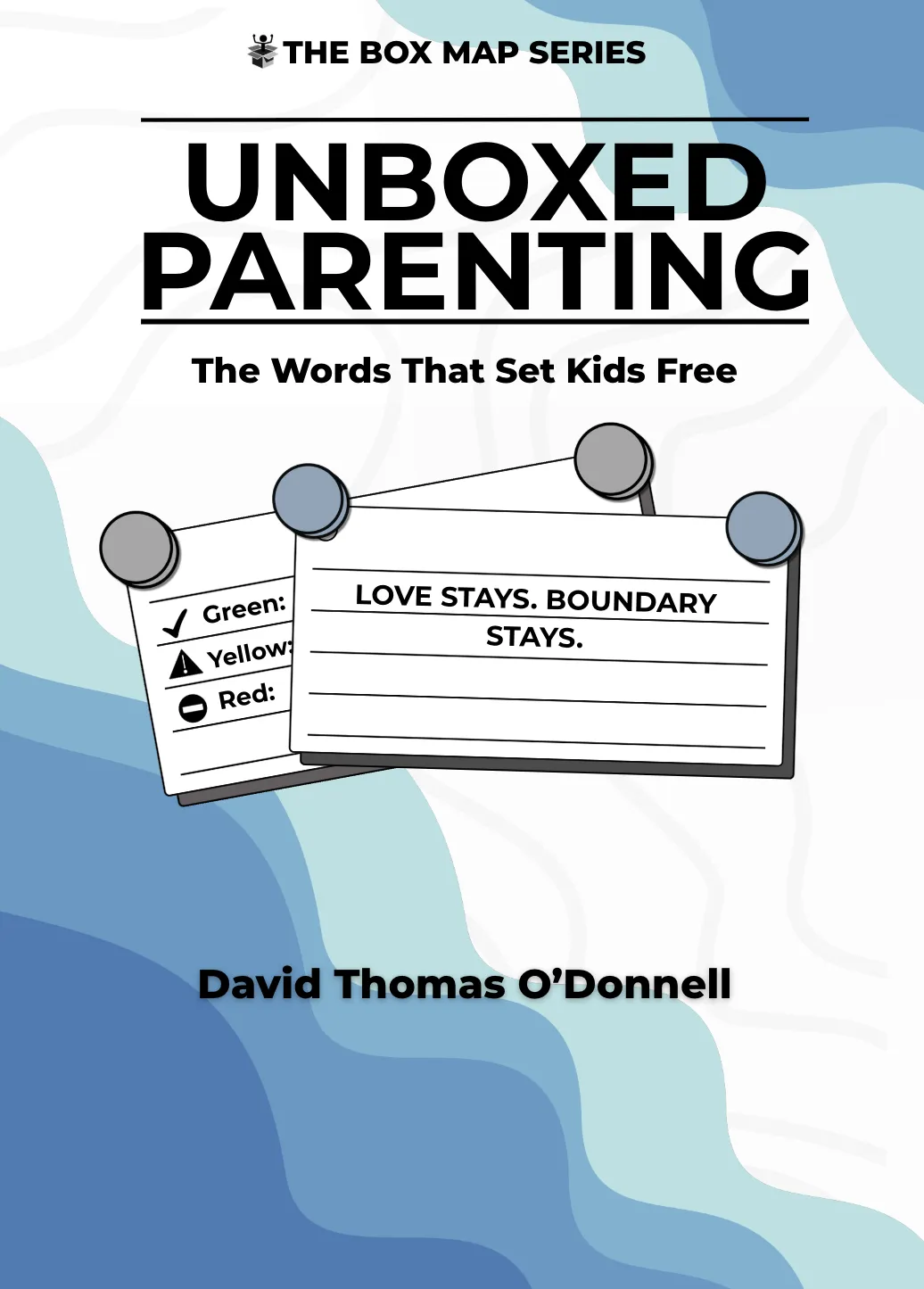
Stop passing invisible Walls to the next generation.
For parents who want boundaries without shame, correction without rejection, and repair without losing authority.
BEYOND THE BOX
Expansion

Build a life that increasingly fits the truth inside you.
For the person who can see the structure and is ready to understand what comes next.
WHERE ARE YOU ON THE MAP?
You do not have to solve the entire structure today.
Begin by noticing what feels most familiar.
The Floor
I feel heavy, depleted, emotionally crowded, or burdened by things I have never fully processed.
The Walls
I recognize old conclusions about who I must be, what I am allowed to want, and what is possible for someone like me.
The Ceiling
I rely on control, certainty, and caution to keep life manageable.
The Fence
I move toward growth and then feel fear, guilt, doubt, or pressure to retreat.
Recognition is enough for now.
You do not have to force an exit.
You only have to stop mistaking the structure for yourself.
START WITH THE FIRST BOOK
You are not lost. You may be contained.
Boxed In is the starting point for The Box Map.
It is not a book about forcing change.
It is a book about seeing clearly.
Because awareness does not need to shout.
It works quietly.
And once you see the Box, it can no longer pretend to be the world.
COMPANY
CUSTOMER CARE
LEGAL


© Copyright 2026. NV, USA. All Rights Reserved.